Debt Collection in Georgia
If you need support in debt collection in Georgia, you can rely on us. Our lawyers in Georgia can help in both amicable and court debt recovery proceedings.

Our lawyers in Georgia explain the main procedures related to debt collection in Georgia. If you need assistance in debt recovery process in Georgia, our law firm can advise and assist you.
| Quick facts | |
|---|---|
| Applicable law | Civil Code of Georgia |
Types of debts that can be collected in Georgia | Debts arising from: – business contracts, – rental agreements, – bank loans, – medical bills, – unpaid taxes, etc. |
Availability of out-of-court procedures (YES/NO) | YES |
| Small claims procedures | Magistrate judges hear property disputes with a value not exceeding GEL 5,000. |
| Duration of amicable debt recovery process in Georgia (approx.) | If the debtor is willing to cooperate, the debt can be resolved within a few days. |
| Duration of debt recovery through court application (approx.) | 3-6 months |
| When to start the debt collection procedure | You can contact our lawyers once the payment due date has passed and the debtor has not made the payment. |
| Mediation | We recommend a mediator to reach a beneficial agreement for both parties. |
| Summons for payment | If amicable attempts to collect the debt have failed, we will send the debtor a summon for payment. |
| Bankruptcy collection | If the debtor is unable to meet his/her financial obligations. |
| Relevant documents for debt collection | – contracts, – invoices, – payment records, – official correspondence, etc. |
| Asset seizure | With a court order, the creditor can confiscate the debtor’s assets to recover outstanding debts. |
| Types of assets subject to seizure | – residential/commercial properties, – bank accounts, – vehicles, – jewelry, – business assets, – intellectual property assets, etc. |
| Enforcing foreign judgments in Georgia | Based on reciprocity agreements with other countries |
| How can our law firm help? | Our attorneys comply with the local regulations regarding debt collection. In case of litigation, we can also represent you in court. |
What is the debt collection legislation in Georgia?
The main law for debt collection in Georgia is the Civil Code which provides for various contractual matters and breaches in agreements. However, other laws containing provisions on debt recovery are the Civil Procedure Code and the Law on Enforcement Proceedings.
What rules of law apply in international debt collection cases?
Provided that the debt collection case involves a foreign party, enforcement can be made following the rules of law prescribed by the following:
- the Law of Georgia on Private International Law;
- the 1958 New York Convention;
- the bilateral treaties signed by Georgia.
What are the main debt collection procedures in Georgia?
There are two main ways of recovering a debt in Georgia – through amicable and court proceedings.
What are the amicable debt collection steps in Georgia?
No matter if either the debtor or the creditor is a Georgian resident or not, the amicable procedure to recover an outstanding amount of money should be used first. In this case, the following steps are usually completed:
- the establishment of the due amount of money and interest or penalty fees;
- gathering of supporting evidence (invoices, contracts, correspondence, confirmation orders);
- the first contact with the debtor which can be made by phone, email or conventional mail;
- reaching an agreement with the debtor for the payment of the outstanding amount of money.
What do I need to do if I can’t recover a debt through the amicable procedure?
If the amicable procedure fails (this usually occurs when the debtor does not respond to the contact attempts of the creditor), a petition with a Georgian court can be filed.
Do I need to be present in court proceedings?
No, you are not legally required to participate in court hearings in connection to debt recovery cases. Your local lawyer can represent you in the procedure.
What do I need to do in order to start court proceedings?
In this case, it is necessary to hire a lawyer who is specialized in debt collection in Georgia, as there are many procedures that must be followed by respecting specific formalities. The court case begins with:
- preparing a claim by following a specific format;
- writing the document in the country’s national language (Georgian);
- submitting it through the judicial system’s online portal or in person;
- receiving online access to the files submitted by both parties.
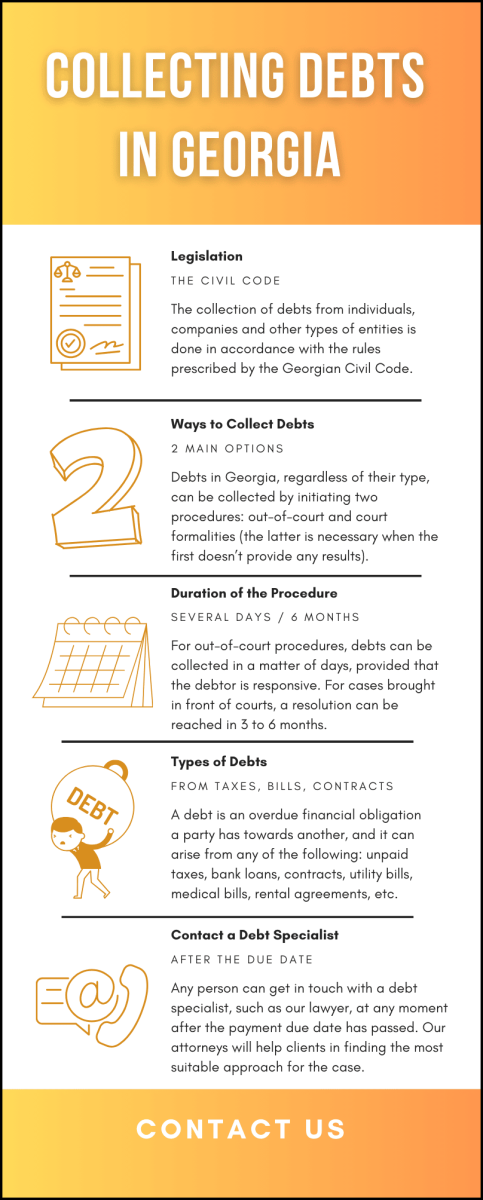
The infographic below presents the main steps in collecting debts in Georgia:
Can I appeal a court decision?
Yes, parties involved in a debt recovery case that is heard in a Georgian court can appeal the ruling of the court, by addressing appellate courts.
What is the deadline to submit an appeal?
Once a decision has been issued by the court of first instance, either party has a period of 14 days to initiate the appeal.
How long does it take to complete a case in the judicial system?
Cases resolved through the judicial system can take longer to complete compared to the out-of-court formalities. In general, it can take an average of 7 months to provide a ruling to a debt collection case.
How can a court decision become legally binding?
If the court issued a ruling and the parties no longer appeal the decision, the ruling of the judges becomes legally binding. This happens through the issuance of an enforcement document, which will state the manner in which debt collection will be conducted in the respective case.
What is the procedure for recovering debts when a foreign creditor is involved?
The steps of debt recovery when a foreign party is involved will follow the next steps:
- our lawyers will verify the laws of the country of the foreign claimant and will align with the Georgian laws applicable in such situations;
- then, we will contact the Georgian debtor and try to reach a settlement for the quick repayment of the debt;
- in case court action is required, we will make sure to file all evidence related to the case;
- we will also offer representation in court proceedings for a suitable outcome;
- once the judgment is issued, we will start the recovery of the outstanding amount of money.
Below, we invite you to watch a short presentation on how to collect debts in Georgia:

Can your Georgian lawyers assist in consumer debt collection?
Our Georgian lawyers also assist in cases involving debt collection from consumers or natural individuals. These debts refer to: credit card balances, medical bills, utility bills, student loans, personal loans, and other forms of consumer credit. Some of these debts might affect the consumer’s credit score and creditworthiness.
Can my assets be seized in debt recovery procedures?
Yes, asset seizure is a legal process conducted in the debt collection procedures in Georgia when debtors fail to fulfill their financial obligations. It involves the seizure or confiscation of the debtor’s assets by creditors to satisfy outstanding debts.
What is the statute of limitations in Georgia?
Statute of limitations refers to the timeframe during which a case can be addressed. In Georgia, the general limitation period is 10 years, but contractual claims (including unpaid invoices) are time-barred after 3 years (6 years for contracts concerning immovable property), counted since the date when the payment was due.
Can you offer debt collection services in other countries?
If you need debt collection services in other countries, such as the Netherlands, we can put you in touch with our local partners.
If you need support in amicable or court debt collection procedures, do not hesitate to contact our law firm in Georgia.
Valeri Bendianishvili, Attorney at Law · 2 October 2026